Invoice vs Receipt vs Bill vs Quote: What Is the Difference?
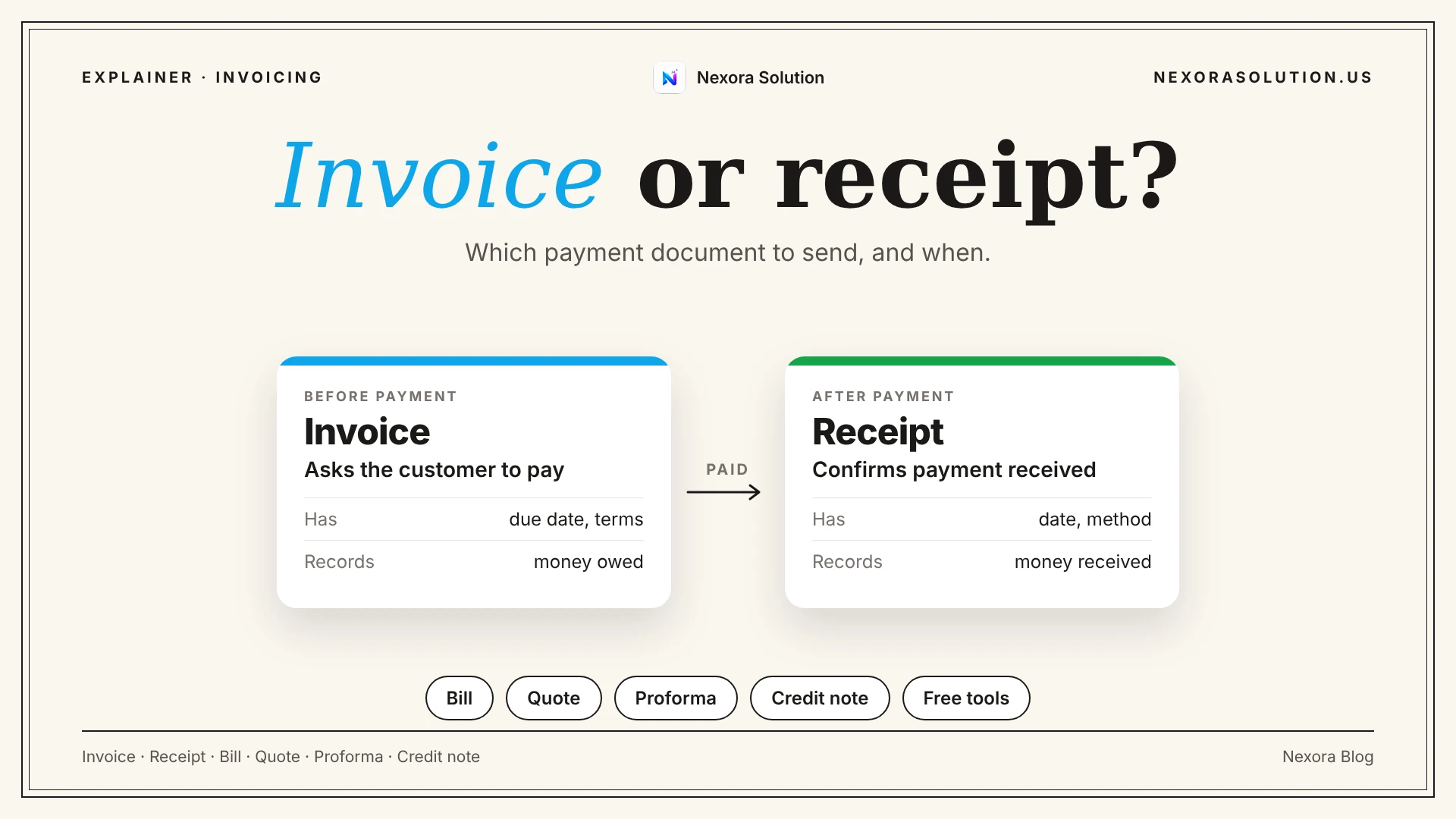
An invoice asks for payment and a receipt confirms it. See how bills, quotes, proforma invoices and credit notes differ, with a worked example and free tools.
What is the difference between an invoice and a receipt?
An invoice asks a customer to pay. A receipt confirms that the customer has paid. You send an invoice before the money arrives, and you issue a receipt after it does. At a shop counter, where payment is instant, the receipt is usually the only document you need.
Everything else in this guide is a variation on those two ideas. A bill is usually an invoice seen from the buyer's side, a quote is a price offer, a proforma invoice is a preview, and a credit note reverses part of an invoice.
Disclosure: Nexora Solution builds the free tools linked in this guide. We kept the definitions general and you should check your own country's tax rules, which differ. This is not legal or tax advice.
Which document is which? A quick table
| Document | What it does | When it is sent | Free tool |
|---|---|---|---|
| Quote or quotation | Offers a price for defined work | Before the work is agreed | Quotation generator |
| Proforma invoice | Previews the sale; not a payment request | Before delivery or final agreement | Proforma invoice generator |
| Purchase order | The buyer's formal order to the seller | By the buyer, before the sale | Purchase order generator |
| Invoice | Requests payment for work done or goods delivered | After delivery, or at agreed stages | Invoice generator |
| Receipt | Confirms payment was received | After payment | Thermal receipt generator |
| Credit note | Reduces what the customer owes, for example after a return | After an error or a return | Credit note generator |
Invoice vs receipt: five differences that matter
Both documents describe the same sale, so they look alike. Five things set them apart.
- Purpose. An invoice is a request. A receipt is proof. Sage's guide puts it the same way: one asks for payment, the other shows that payment was made.
- Timing. Invoices go out before payment, sometimes at several stages of a project. Receipts come after each payment.
- Fields. An invoice carries a number, an issue date, a due date, itemised lines, tax and payment terms. A receipt needs the payment date, the method and the amount received, and the due date drops away.
- Accounting record. An unpaid invoice is money owed to you. A receipt records that the money has come in.
- Who asks for it. Customers who pay later need the invoice to process payment. Customers who pay on the spot, or who claim an expense, usually want the receipt.
If you only need the till version of the receipt, see how to print one on 58mm or 80mm paper with the free thermal receipt generator.
Is a bill the same as an invoice?
Mostly, yes. A bill is what the buyer calls the document the seller calls an invoice. When you send it, it is an invoice. When you receive it, it is a bill to pay. The Helcim guide to invoices, receipts and other documents makes the same point and adds a useful habit: a restaurant bill is due on the spot, while an invoice usually has a later due date.
So if a customer asks for a "bill", send an invoice with a clear due date and your payment details.
Quote vs estimate vs proforma invoice: which comes first?
These three come before the sale, and they are easy to mix up.
- Estimate: a rough price when the full scope is not known. The final figure can move up or down.
- Quote: a written, specific price for defined work. Once the customer accepts it, the price is normally binding.
- Proforma invoice: a preview of the invoice, often used for advance payment or customs paperwork. It is not a request to pay and is replaced by the final invoice later.
Use an estimate when you are unsure, a quote when the job is clear, and a proforma when the buyer needs paperwork before delivery. In the Nexora quotation tool, an accepted quote converts to an invoice or a proforma, so you do not retype the items.
How do the documents fit together? A worked example
Here is one web design job from first price to final payment. The amounts are assumptions for illustration.
| Step | Document | Amount | What it says |
|---|---|---|---|
| 1 | Quote Q-0001 | $2,400 | Price for the full job, valid for 30 days |
| 2 | Deposit invoice INV-0001 | $600 | 25% deposit due before work starts |
| 3 | Deposit receipt | $600 | Marked as a deposit, so the client still owes $1,800 |
| 4 | Final invoice INV-0002 | $1,800 | Balance due on delivery |
| 5 | Final receipt | $1,800 | Payment received, balance $0 |
Check the arithmetic: $600 + $1,800 = $2,400. Two receipts, each for the amount actually received, keep the record honest. If the client later returns part of the work, a credit note for the amount reversed goes against the original invoice rather than editing it.
Can an invoice marked paid work as a receipt?
Often, yes. An invoice that shows the word Paid, the payment date, the method and a zero balance records the same facts a receipt does. Some customers still ask for a separate receipt for their own records or expense claims, so be ready to send one.
The safe rule is to mark an invoice as paid only after the money has actually arrived. Sending an invoice is not the same as being paid. In the free invoice generator you add each payment with its date and method, and the invoice shows what was paid and the balance still due. The Mark as paid button settles the rest in one click.
What are the most common mistakes?
- A receipt for the full amount after a part payment. A receipt should confirm only what was received. Label deposits as deposits.
- Reusing or skipping numbers. Give every invoice, receipt and credit note a unique number in its own series, such as INV-0001 and CN-0001.
- No due date or payment details on an invoice. Without them the customer does not know when or how to pay.
- Editing an issued invoice to fix a mistake. Issue a credit note and a corrected invoice so the paper trail stays clean.
- Mixing up a quote and a proforma. A quote is an offer. A proforma is a preview of a sale that has been agreed in principle.
Whatever you send, keep a copy of every document and match your invoices and receipts against your bank statement at month end.
Which document should you use in your situation?
| Situation | Send this |
|---|---|
| Customer pays at the counter | Receipt |
| Freelancer bills a client for finished work | Invoice, then a receipt when paid |
| Client wants a price before agreeing | Quote |
| Overseas buyer needs paperwork before shipping | Proforma invoice |
| Customer returns goods you have already invoiced | Credit note |
| You are the buyer ordering from a supplier | Purchase order |
Which free tools make each document?
Nexora has free browser tools for each document in this guide. There is no signup and no watermark, and the documents stay in your browser. The free invoice generator adds taxes, discounts and part payments and exports PDF or Excel. The quotation generator and proforma invoice generator cover the steps before the sale, and the credit note generator handles returns.
These tools make one document at a time. They are not accounting software, so they do not file taxes or reconcile your bank. If you need customers, invoices, payments and reports in one place, see Nexora's CRM and business suite with its 1-month free trial.
Frequently Asked Questions
What is the main difference between an invoice and a receipt?
An invoice requests payment and a receipt confirms it. You send an invoice before you are paid and a receipt after the money arrives.
Is a bill the same as an invoice?
Usually yes. A bill is the same document seen from the buyer's side. The seller calls it an invoice and the buyer calls it a bill.
Can I use an invoice as a receipt?
Sometimes. An invoice marked paid, with the payment date, method and a zero balance, records the same facts. Some customers still want a separate receipt for expense claims.
Do I need both an invoice and a receipt?
For credit sales, yes: an invoice first and a receipt when payment arrives. For sales paid on the spot, a receipt alone is usually enough. Check your local tax rules.
What is the difference between a quote and an invoice?
A quote offers a price before the work is agreed. An invoice asks for payment after the work is done or at agreed stages.
Is a proforma invoice a real invoice?
Not usually. It previews a sale before delivery and does not request payment. The final invoice replaces it later.
Related Articles
- Invoice vs Receipt vs Delivery Note vs Credit Note: Which Do You Need? — 1 min read
- Free Invoice Generators Compared: What "Free" Really Means — 1 min read
- Free Invoice Generator USA | Create Free Invoices Online — 1 min read
- Free Invoice Generator for Small Businesses in the USA: How to Create a Professional Invoice — 1 min read