Answer-First Writing: How to Structure a Page So AI Can Quote It
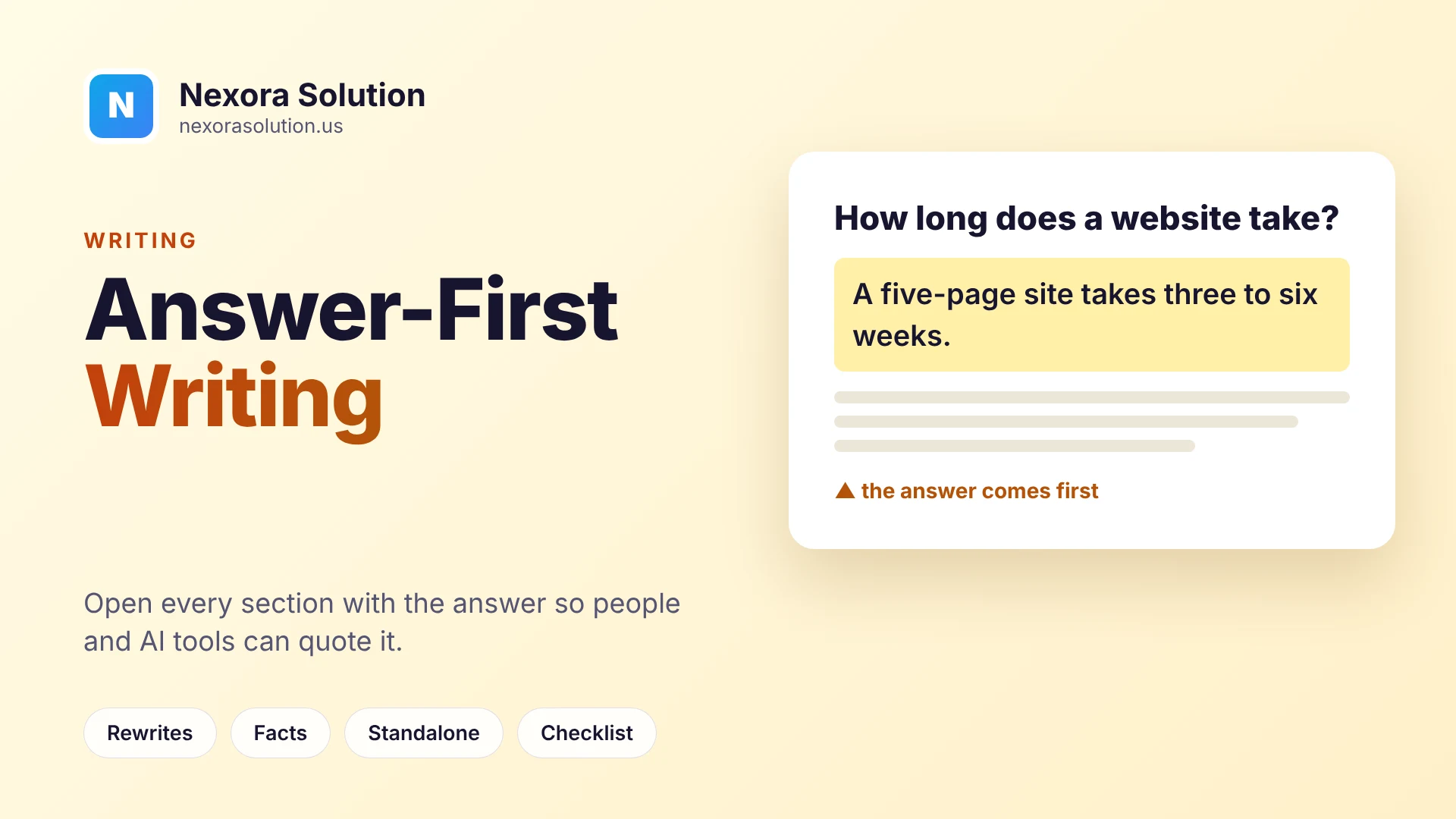
Practical before-and-after rewrites showing how to open each section with the answer, use facts instead of slogans, and keep every passage understandable on its own.
The paragraph that buries its point
Here is the opening of a section from a real kind of business website, lightly changed:
"At our company, we believe that great service starts with listening. Over the years we have worked with many clients across different industries, and we have learned that every project is unique. That is why, when people ask us how long a website takes to build, the answer is always: it depends."
Nothing in it is false. And nothing in it can be quoted. If a person asks an AI tool how long a website takes to build, there is no sentence on this page for the tool to lift, because the answer is hidden behind three sentences of warm-up and ends in "it depends."
Now compare:
"A typical five-page business website takes three to six weeks from the first call to launch. Most of that time is waiting for text and images from the client, not building."
The second version is not clever. It has just done what a good teacher does: answer first, explain after. This article is about doing that deliberately across a whole page, and doing it without turning your writing into a list of stiff definitions.
Why the opening lines matter more than they used to
Three things have changed about how pages get read.
People skim. They always did, and they read the first lines under a heading and decide whether to continue.
Search engines have shown short extracted answers for years, as featured snippets. They pick a passage that answers the question directly.
AI tools go a step further. When they build an answer, they pull passages from several pages, summarise or quote them, and often link back. A passage that makes sense on its own, states the point plainly and contains a checkable fact is much easier to use than one that depends on the three paragraphs before it.
None of this guarantees a citation. A tool picks sources based on many things, including how trusted your site is, whether other sites mention you, and the exact question asked. What you control is whether your page offers a clean passage when it is considered. That is the part this article covers.
The shape of an answer-first section
The pattern is short enough to remember.
1. A heading that matches a real question or topic. "How long does a website take to build?" works better than "Our timelines."
2. One or two sentences that answer it. A figure, a definition, a yes or a no. Typically somewhere between 30 and 60 words. That range is a writing habit, not a measured rule, and nobody has shown that 58 words outperforms 70. It is simply long enough to say something and short enough to be lifted whole.
3. The detail underneath. The conditions, the exceptions, the reasoning, an example. The reader who wants more continues. The reader who wants the answer already has it.
The structure serves both sides. A hurried human gets the answer first, and a piece of software gets a passage with a clear boundary.
Five rewrites you can copy
The best way to learn the move is to see it applied.
Rewrite 1: the slogan
Before: "We deliver value through innovative, client-first solutions."
After: "We build custom CRM, POS and school software for small and mid-sized businesses in Pakistan, with a free one-month trial on every plan."
The first sentence could be on any company's website. The second says what the company does, for whom, and one concrete term. A slogan has no content for a machine to quote, because it does not claim anything checkable.
Rewrite 2: the "it depends"
Before: "The cost of a logo depends on many factors."
After: "A freelance logo usually costs between $50 and $500, depending on whether it comes with brand guidelines and revisions. Agencies charge more."
Notice that "depends" has not been banned. It moved after the number. The range gives the reader something to hold, and the reason for the range follows.
Rewrite 3: the definition buried in history
Before: "Over the last decade, the way businesses handle invoices has changed. Today, there is a document called a pro forma invoice, which many sellers use."
After: "A pro forma invoice is a preliminary bill sent before goods or services are delivered, so the buyer knows what they will owe. It is not a demand for payment and usually does not go into the accounts as a sale."
Start with the term, say what it is, then add the context. This is also how the best encyclopaedia entries open.
Rewrite 4: the vague "many"
Before: "Many customers say our software saves them a lot of time."
After (with made-up numbers, to show the shape): "In a test on three customer accounts, month-end closing dropped from two days to half a day."
Only write the after version if it is true and you can show where it comes from. If you do not have a figure, say something smaller and real: "Closing the till takes one button instead of a paper count." Invented numbers are worse than vague ones.
Rewrite 5: the pronoun
Before: "It also supports this. That is why they recommend it."
After: "The tool also supports barcode billing, which is why retailers use it at the counter."
A passage pulled out of context has no "it" to point at. Name the thing. This is the quietest change and one of the most useful.
Make each passage stand on its own
When a tool lifts a paragraph, it loses the paragraphs around it. Test your own writing by reading one paragraph in isolation and asking: if this were all you saw, would it make sense?
Useful habits:
- Repeat the subject by name at the start of the section instead of relying on "this" and "they."
- State units, currency and dates, not "recently" or "a small fee."
- Put the qualifying condition in the same sentence as the claim, not three paragraphs later.
- Avoid references such as "as we said above" or "see the next section" in the answer itself.
None of this makes the writing worse for human readers. If anything, it removes the small friction of having to remember what "it" was.
A whole page, before and after
Take a services page for a bookkeeping firm. The first version has the headings "Welcome", "Why choose us" and "Get in touch". Under "Welcome" there is a paragraph about the firm's passion for numbers.
The rewritten version has headings such as "What does a bookkeeper do for a small business?", "How much does monthly bookkeeping cost?" and "How long does it take to catch up on a year of missing records?". Under each one, the first sentence gives the answer. The cost section starts with a range and the main thing that moves it. The catch-up section starts with a typical time and the condition that changes it. The page has not become longer. It has become findable, because a reader who types one of those questions lands on a page that answers it in the first line.
Notice what stayed the same: the firm's voice, its examples and its call to action. Answer-first is a rule about where the point goes, not about how the writing sounds.
Facts do more than adjectives
Compare "an affordable, fast service" with "from $50, delivered in five working days." The second is a claim a reader can check and a tool can repeat. It is also the kind of sentence that gets corrected if it is wrong, which is a form of accountability that adjectives lack.
GeoLint, our free audit at https://nexorasolution.us/tools/geo-audit, measures this. It counts specific numbers per 100 words and links to other sites, and its targets are about two numeric facts per 100 words and links to three outside sources for full points. We call those targets for readable, citable pages, not guarantees of citation. The point of the targets is the habit: say a number, and name where it came from.
Linking out looks counterintuitive, because people fear losing readers. In practice, a link to a standard, a study or an official page shows where a claim comes from. It makes you easier to trust, for people and for software that weighs sources. Link to the primary source when there is one, not to another blog summarising it.
Structure that helps without shouting
You do not need to rewrite everything as bullets. Some content does fit a list or a table better than a paragraph.
Use a numbered list for steps in an order. Use a table for comparisons with the same attributes. Use a short definition sentence for terms. Use plain paragraphs for reasoning and judgement. A page made of nothing but bullets reads like a slide deck, and a page made of nothing but paragraphs hides its structure.
Headings deserve a quick audit too. A list of your H2s should read like an outline of the answers. If your headings are "Overview", "Our approach" and "Conclusion", the outline says nothing. If they are "What a pro forma invoice contains", "When to send one" and "How it differs from a quotation", it says a lot.
Do not overdo it
Chasing structure has its own failure modes.
Do not write in a robotic voice. If every paragraph reads like a dictionary entry, people will leave. The answer-first sentence is one sentence. What follows can be as human as you like, with examples and opinions.
Do not stuff headings with keywords. A heading is a question a person would ask, not a phrase repeated for effect.
Do not copy the same definition on fifty pages. Duplicate answers dilute each other. One strong page per question beats many thin ones.
Do not fake freshness. Changing the date without changing the content misleads readers and does nothing for you. Update the page when something is actually revised, and show the date honestly.
Do not claim certainty you lack. "It depends" is sometimes the correct answer. Say what it depends on, and put the typical case first.
A simple review you can run on any page
Take one page you want to be found, and go through these.
- List the H2s. Do they read like answers or like labels?
- Under each, read the first two sentences. Does the reader get the point?
- Count the numbers. Does the page contain any figure with a source?
- Look for pronouns at the start of sections.
- Look for claims with no evidence and either add the evidence or soften the claim.
- Add a visible last-updated date.
GeoLint runs a version of this check on the first block under each H2 and H3. It rewards a direct statement, a number or a list and flags filler openings, very short lines and very long paragraphs. It labels the check as a heuristic, because nobody has proven the ideal length. A low score here is a prompt to read the page again, not a verdict.
Where this fits among the other fixes
Writing is the third step, not the first. A page that crawlers cannot reach, or that arrives as an empty shell, gains nothing from better headings. Check access first, as described in https://nexorasolution.us/blog/react-vue-angular-site-invisible-to-ai-crawlers-javascript, and then improve the words. Structured data is the finishing layer, covered in https://nexorasolution.us/blog/json-ld-schema-markup-for-ai-search-what-matters. And once the work is done, you can see whether it is bringing visitors using the setup in https://nexorasolution.us/blog/track-chatgpt-ai-search-traffic-google-analytics-4.
Frequently Asked Questions
What is answer-first content?
Content where each section opens with the direct answer, figure or definition, followed by the detail. It helps readers who skim and gives search and AI tools a passage that can be quoted.
How long should the opening answer be?
Around 30 to 60 words is a common convention, long enough to say something and short enough to lift whole. It is a writing habit, not a proven threshold.
Will answer-first writing get me cited by ChatGPT?
Not by itself. Citations depend on access, authority, mentions elsewhere and the question asked. Clear passages improve the odds that a usable one exists.
Should I turn all my content into bullet points?
No. Use lists for steps and tables for comparisons, and keep paragraphs for reasoning. A page of only bullets is hard to read.
Is it wrong to say "it depends"?
No, as long as you give the typical answer first and then say what it depends on.
Do I need to link to other sites?
Linking to primary sources such as standards, studies and official pages shows where claims come from and makes the page easier to trust.
Related Articles
- Schema Markup for AI Search: Which JSON-LD Types Are Worth Adding — 1 min read
- Is Your React, Vue or Angular Site Invisible to AI Crawlers? — 1 min read
- How to See Traffic from ChatGPT, Claude and Perplexity in Google Analytics 4 — 1 min read
- GST Invoice Format in India: Mandatory Fields and When E-Invoicing Applies — 1 min read