Invoice Numbers: Formats, Examples and the Mistakes to Avoid
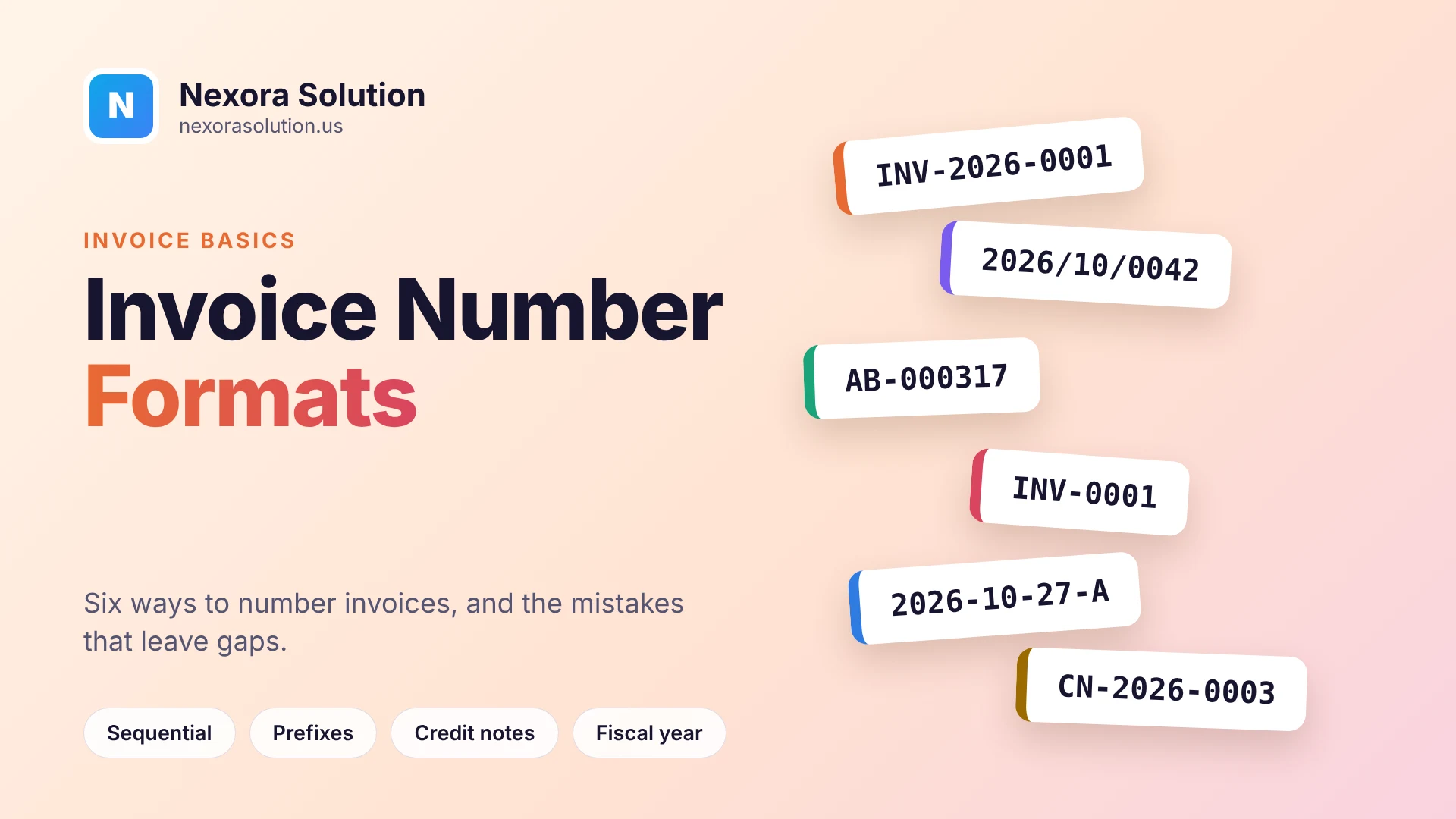
Six invoice number formats with examples, what tax rules say about sequential numbering, how to handle credit notes and a mid-year start, and the mistakes to avoid.
An invoice number is a lookup key, not decoration
Most people pick an invoice number the way they pick a filename, quickly and without much thought, and then live with the choice for years. That is fine until a customer pays you AED 4,200 with the reference "last month's invoice", or until your accountant asks why there is no INV-0047, or until two invoices turn out to share a number and neither of you can say which one was real.
The number does a small number of jobs. It tells the customer what to quote when they pay. It lets you find the document again in a year. It gives your accountant a series to check for gaps. And in many countries it is not optional: tax rules ask for a number that is unique and sequential. The job of a numbering scheme is to make all four easy without thinking about it again.
We make free invoice tools, so this is a topic we get questions about. Below are the formats people actually use, what three tax systems say, and a way to choose that you will not regret in 2028.
What the rules say in three places
The wording differs, but the idea is the same everywhere we looked.
United Kingdom. HMRC's manual on VAT records lists the details a full VAT invoice must show. First on the list is a sequential number based on one or more series that uniquely identifies the document. The same page says that if you begin numbering at something other than 1, the series must run consecutively from that point.
India. A summary of Rule 46 of the GST rules from Tally Solutions describes the invoice number as a consecutive serial number, unique for the financial year, up to 16 characters long. If you invoice in India, the "financial year" part matters, because it runs April to March and not January to December.
United Arab Emirates. Published summaries of Article 59 of the VAT Executive Regulation list a sequential invoice number among the fields of a full tax invoice.
Notice the phrase "one or more series" in the UK wording. You are allowed more than one series, for example one per branch, as long as each is consecutive and no number repeats. What you are not allowed to do is reuse a number or leave gaps you cannot explain. If your country is not listed here, check its tax authority's page, because some places have no rule at all and some have strict ones.
Six formats and when each one fits
There is no best format, only a best format for how you work. These are the six we see most.
| Format | Example | Works well for | Watch out for |
|---|---|---|---|
| Plain counter | 1001, 1002, 1003 | Freelancers, low volume | Nothing tells you the year, and it is easy to restart by accident |
| Prefix and counter | INV-0001 | Anyone who also issues quotes and credit notes | You must keep each prefix in its own series |
| Year and counter | INV-2026-0001 | Most small businesses | Resets every January, so the year has to be in the number |
| Year, month and counter | 2026-10-014 | Busy shops and agencies | Monthly resets mean more series to check for gaps |
| Client code and counter | ACME-007 | Agencies with a few retainer clients | Harder to show an unbroken sequence to an auditor |
| Branch, year and counter | LHR-2026-0231 | Several outlets or warehouses | Each branch needs its own person watching its series |
If you cannot decide, the year-and-counter format is the safe default. It is readable at a glance, it sorts well and it behaves predictably when the calendar flips. It is also the shape our own generator uses, which we come back to below.
Four decisions that fix the format for good
A scheme is really four small choices, and making them on purpose takes five minutes.
1. The prefix. Use letters to say what the document is. INV for invoices, CN for credit notes, QUO for quotes, PO for purchase orders, DN for delivery notes. This is what keeps your series apart and lets you tell a document type at a glance.
2. The year. Put it in. If you leave it out, a counter that resets in January will produce a second invoice 0001 and the unique number you were supposed to have is gone. If you invoice in India or anywhere else with a split financial year, use the financial year (2026-27) and not the calendar one.
3. The padding. Fill the counter with leading zeros to a fixed width. This is not cosmetic, it is how sorting works. Spreadsheets and file folders sort text one character at a time, so without padding the list INV-1, INV-2, INV-10, INV-11 sorts as INV-1, INV-10, INV-11, INV-2. With four digits it sorts correctly forever. Pick the width from your volume: at 40 invoices a day, four digits run out in about 250 days, so a busy business wants five.
4. The reset rule. Decide whether the counter restarts every year or runs on indefinitely. Restarting each year with the year in the prefix is the usual answer, because it keeps numbers short and each year's accounts self-contained. A counter that never resets is simpler but grows without bound and has no natural year marker.
Starting in the middle of a sequence
You will not always begin on 1 January with a clean slate. Maybe you moved from another invoicing tool in August, or you are taking over a business, or you simply started trading in March. The rule from the UK guidance covers this: begin wherever you need to, then run consecutively from that point.
In practice that means finding the last number you used anywhere, adding one and carrying on. If the old tool issued INV-2026-0038 on the last day, your first invoice in the new tool is INV-2026-0039, not INV-2026-0001. Starting again from the beginning would produce duplicate numbers for the same year, which is exactly what the sequential rule exists to prevent.
A tool that lets you type your own number makes this painless. Ours does, and the https://nexorasolution.us/tools/invoice-generator will carry on counting from whatever you enter.
Credit notes, quotes and the documents around an invoice
An invoice rarely travels alone. A quote comes before it, a delivery note travels with the goods, and a credit note can cancel or reduce it afterwards. Each of those documents needs a number, and the cleanest approach is a separate series for each type.
- Credit notes get their own series, for example CN-2026-0001, and each one should refer to the invoice it corrects by number. Do not edit a sent invoice to fix it. Issue a credit note for the wrong one and a fresh invoice with the right figures. Many tax systems expect this, and even where they do not, it leaves a clear trail.
- Quotes and proforma invoices are not tax invoices, so their numbers do not need to follow tax rules. They are still worth numbering, because a number on a quote makes it easy to say "the one you accepted". Our post on https://nexorasolution.us/blog/quotation-vs-proforma-invoice-vs-purchase-order explains where each of those documents sits.
- Delivery notes travel without prices and are numbered separately. If you want one document to follow the other, put the delivery note number on the invoice.
The point of separate series is that a gap in invoices is a finding, while a gap in quotes is just a quote nobody accepted.
Mistakes that cause gaps and duplicates
After enough years of looking at other people's invoice lists, the same few problems keep appearing.
- Deleting a draft that already has a number. If the number was allocated and then the draft disappeared, you now have a gap. Void the document and keep it in your records with the status cancelled, so the gap has an explanation.
- Two people, two spreadsheets. One person issues from a laptop and another from a phone, and each starts their own count. The first duplicate is only found when a customer calls about it. One source of numbers, or one person who allocates them, is the whole fix.
- Reusing a number after an error. If INV-0112 was sent with the wrong customer on it, INV-0112 is spent. The correction is a credit note plus INV-0113, not a quiet rewrite of 0112.
- Dropping the year. A tidy 1, 2, 3 series is fine until January, when a restart creates numbers that already exist in last year's folder.
- Encoding private information. A number such as ACME-RETAINER-5000 tells every customer who sees a copy something about another customer. Keep numbers boring.
- Starting at 1000 to look established. Some people do this so that new customers do not see INV-0001. It is harmless, but it does nothing for anyone, because customers see your numbers and cannot tell what they mean.
A worked example: one scheme for a small design studio
Take a studio with six regular clients that bills about 30 invoices a month, sends a quote before most jobs and occasionally refunds part of a bill. Thirty a month is 360 a year, so four digits are generous.
Their scheme: INV-2026-0001 for invoices, CN-2026-0001 for credit notes and QUO-2026-0001 for quotes, each counter starting again in January. When a quote is accepted, the invoice for the job carries the quote number in a reference line, so a customer who says "the one from the Lahore project" can be matched to QUO-2026-0042 and then to INV-2026-0118 in about ten seconds.
In March a client disputes a line on INV-2026-0031. The studio does not edit it. It issues CN-2026-0004 for the disputed amount, quoting INV-2026-0031, and then issues INV-2026-0132 for what is actually owed. Three documents, three clear numbers, and an accountant who can follow the story without a phone call.
If this studio traded in India, one change would be needed. A financial year that starts in April means the counter restarts in April, and the year part of the number becomes 2026-27. Be careful with length when you do that, because a format such as INV-2026-27-0001 is exactly 16 characters, which is the most the rule summarised above allows. A shorter prefix or a two-digit year pair leaves room for a branch code.
Numbering in a spreadsheet without breaking the sequence
Plenty of small businesses still keep an invoice register in a spreadsheet. It works, with two habits. Keep one row per document and never delete a row, and let a formula build the number so nobody types it. If column A holds the counter and column B holds the invoice date, this formula in column C produces the shape used above:
="INV-"&TEXT(B2,"yyyy")&"-"&TEXT(A2,"0000")
The TEXT function with "0000" is what pads the counter, and the year comes from the date, so the number changes only when the date does. Add a status column with values such as issued, paid, void and credited. A cancelled invoice stays in the register as void, so the sequence on the page has no unexplained holes.
The weakness of a spreadsheet is the same as before: it is one file. If two people open copies, you have two registers.
How the free generator numbers invoices
The Nexora free invoice generator gives each new invoice the next number in a series on your device, in the shape INV-2026-0007. You can type a different number instead, which is how you continue a sequence from another system. The tool runs entirely in your browser, which has one consequence worth knowing: the counter lives on the device where you made the invoice.
If you invoice from a laptop and a phone, those are two counters. The two ways to keep them in step are to type the number yourself whenever you switch device, or to export a backup from one and import it on the other before you carry on. If several people in a team must share one series, that is a job for software with a server behind it, and https://nexorasolution.us/crm/invoices is Nexora's cloud option for it.
For tax-specific versions of the same tool, the https://nexorasolution.us/tools/gst-invoice-generator covers India, the https://nexorasolution.us/tools/pakistan-invoice-generator covers rupee invoices with NTN and STRN, and the https://nexorasolution.us/tools/uae-vat-invoice-generator covers dirhams and TRN. Pakistani businesses should also read https://nexorasolution.us/blog/pakistan-sales-tax-invoice-fbr-digital-invoicing for the FBR side.
A short checklist before you issue invoice number one
- Choose a prefix per document type.
- Put the year, or the financial year, in the number.
- Pad the counter to a fixed width that fits your volume.
- Decide whether the counter resets each year.
- Give credit notes, quotes and delivery notes their own series.
- Write the format on a page and keep it with your accounts, so a new colleague or accountant can follow it.
Comparing tools first? https://nexorasolution.us/blog/free-invoice-generators-compared-no-signup-no-watermark looks at what free means across generators.
Frequently Asked Questions
Do invoice numbers have to be sequential?
In the UK, India and the UAE, the published guidance we read asks for a sequential or consecutive number. Check your own tax authority. Even where it is optional, an unbroken series makes your records far easier to audit.
What is a good invoice number format?
A prefix, the year and a padded counter, such as INV-2026-0001, is a safe default. It sorts correctly, shows the year and keeps credit notes and quotes in their own series.
Can I start my invoice numbers at 1000?
You can. Nothing in the guidance we read forbids it, as long as the series then runs consecutively. It will not make a new business look established, though, because customers cannot tell how many invoices you have issued.
What should I do if I skip an invoice number?
Record why. If a draft was cancelled, keep it in your files marked void. If a number was used in error, leave it as it is and issue a credit note, then use the next number for the corrected invoice.
Should credit notes have their own number series?
Yes, in most setups. A series such as CN-2026-0001 keeps the invoice sequence clean, and each credit note should name the invoice it corrects.
Does the free Nexora invoice generator keep my invoice numbers in sync across devices?
No. Invoices and the counter live in your browser on one device. You can type the number yourself, or export a backup on one device and import it on the other.